
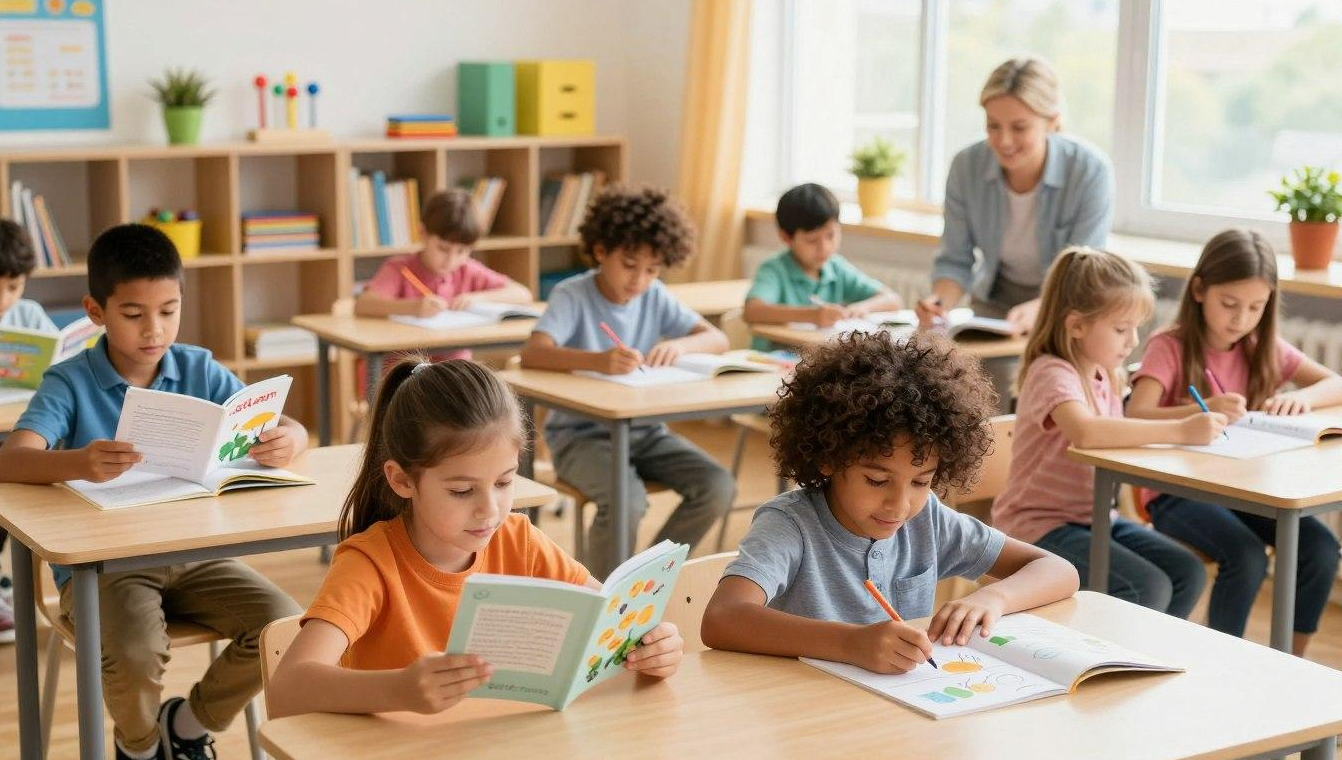
Primary education is one of the most important stages in a child’s learning journey. It introduces children to essential academic knowledge while helping them develop communication, problem-solving, social, emotional, and practical skills. According to UNESCO’s education classification, primary education is designed to build foundational skills in reading, writing, mathematics, and other core areas while preparing children for further education. Suggested image alt text: Primary education students learning reading, mathematics, and classroom activities with a teacher What Is Primary Education? Primary education is the first major stage of formal schooling, generally following preschool or early childhood education and coming before secondary education. Its main purpose is to give children a strong foundation in areas such as: The exact age range and number of grades differ between countries. UNICEF notes that primary education is typically designed for children around 6 to 11 years old. Why Is Primary Education Important? Primary education establishes many of the skills children use throughout their academic and personal lives. Strong foundations in literacy and numeracy can make it easier for students to understand more advanced subjects later. Primary school also gives children opportunities to develop confidence, cooperation, communication, independence, and learning habits. 1. Builds Literacy Skills Reading and writing are fundamental parts of primary education. Children learn vocabulary, sentence structure, reading comprehension, spelling, and written communication. Strong literacy skills help students understand textbooks, instructions, stories, and information across different subjects. 2. Develops Numeracy Mathematics is another essential part of primary education. Children gradually learn numbers, addition, subtraction, multiplication, division, measurement, patterns, geometry, and problem-solving. UNICEF’s foundational learning framework highlights number identification, comparison, addition, and pattern recognition as important early numeracy skills. 3. Encourages Social Development School provides children with regular opportunities to interact with classmates and teachers. Through group activities and classroom routines, students can learn cooperation, communication, responsibility, and respect. 4. Develops Confidence and Independence Primary school encourages children to complete tasks, ask questions, express ideas, and solve age-appropriate problems independently. These experiences can gradually build confidence. 5. Creates a Foundation for Future Learning Primary education prepares children for secondary education by developing basic academic knowledge and learning habits. It is therefore much more than memorizing information—it helps children learn how to learn. Main Objectives of Primary Education The objectives of primary education can vary depending on the country and curriculum, but common goals include: Primary education also has an important role in developing collaboration and social-emotional skills alongside academic knowledge. Primary Education Curriculum A primary education curriculum usually combines core academic subjects with creative, physical, and social learning. Language and Literacy Students develop reading, writing, speaking, listening, vocabulary, grammar, and comprehension skills. Mathematics Common topics include: Science Science lessons introduce children to nature, animals, plants, the human body, materials, the environment, and basic scientific concepts. Social Studies Children learn about their communities, cultures, geography, history, citizenship, and the wider world. Art and Creative Learning Drawing, painting, crafts, music, drama, and other creative activities can help children express ideas and develop imagination. Physical Education Physical activities encourage movement, coordination, teamwork, healthy habits, and physical development. Effective Teaching Methods in Primary Education Young children often benefit from learning experiences that are active, engaging, and connected to real-life situations. Activity-Based Learning Instead of relying entirely on lectures, teachers can use games, experiments, projects, puzzles, demonstrations, and hands-on activities. Kendriya Vidyalaya Sangathan describes activity-based teaching as an approach used at the primary level to make learning more active and engaging. Story-Based Learning Stories can make lessons easier to understand and remember. Teachers can use storytelling to introduce language, science, values, history, and social concepts. Visual Learning Pictures, charts, flashcards, educational illustrations, videos, maps, and diagrams can help children understand unfamiliar concepts. Group Activities Pair and group activities encourage students to communicate, cooperate, share ideas, and solve problems together. Learning Through Play Games and playful activities can make lessons enjoyable while allowing children to practice academic and social skills. Role of Teachers in Primary Education Primary school teachers play an important role in creating a safe, supportive, and engaging learning environment. An effective primary teacher can: Teachers are especially important because children may enter primary school with very different levels of readiness and prior learning. Role of Parents in Primary Education Parents and families can support primary education beyond the classroom. Simple activities can make a significant difference, such as: A supportive home environment can complement what children learn at school. Technology in Primary Education Digital technology is increasingly being used to support primary learning. Educational videos, interactive exercises, digital books, learning platforms, and educational games can supplement classroom instruction. However, technology works best when it supports clear learning objectives rather than replacing meaningful interaction with teachers and classmates. UNICEF identifies digital learning as one tool that can support access to quality primary education, particularly when combined with broader education-system improvements. Suggested image alt text: Primary school children using books, digital learning tools, and classroom activities Importance of Inclusive Primary Education Every child should have an opportunity to learn regardless of gender, disability, language, economic circumstances, or background. Inclusive primary education aims to reduce barriers that prevent children from participating fully in school. UNICEF emphasizes the importance of equitable access and support for children who face disadvantages. Schools can promote inclusion through: Primary Education in India In India, primary education forms an important part of the school education system. The early grades are particularly important for establishing foundational literacy and numeracy. UNICEF India highlights the importance of quality teaching and learning, early childhood education, and school readiness in improving children’s educational outcomes. For Indian schools, primary education can combine academic learning with activity-based teaching, local context, creative activities, and age-appropriate assessment. How to Improve Primary Education Improving primary education requires attention to both access and learning quality. Important areas include: Primary Education and Foundational Learning One of the biggest goals of primary education is ensuring that children acquire foundational skills rather than simply attend school. UNICEF data shows that access to primary education has improved globally, but many children